Top 15 Agritech Startups in Spain: Funding & Innovation
Which Spanish agritech startups are truly innovating, and which simply make big promises? Finding the top agritech startups in Spain isn’t as easy as checking online rankings. Many startup lists lack updated funding information, clear technologies, or evidence of real agricultural impact.
Spain faces growing pressure from water shortages, rising costs, and changing agricultural demands. Choosing unreliable startup information can waste valuable time and lead to poor investment decisions. Farmers and investors need accurate comparisons before trusting new agricultural technologies.
This article explores 15 leading agritech companies in Spain, their innovations, and reported funding. You’ll discover their technologies, business activities, and the farming problems they aim to solve. You’ll also learn how these companies compare and which deserve closer attention.
Top 15 Agritech Startups in Spain
The top agritech startups in Spain include GrodiTech, Voltrac, Spherag, IKOS Advanced, Innogando, and Neboda. These companies develop technologies for greenhouse automation, precision irrigation, livestock monitoring, and sustainable crop production. Their products address agricultural challenges involving water consumption, labor requirements, and operating efficiency.
Spain’s agritech sector includes early-stage startups alongside more established technology businesses. The ICEX and Cajamar ecosystem report documents agricultural innovation across Spanish regions. However, funding alone cannot determine which company is the most successful.
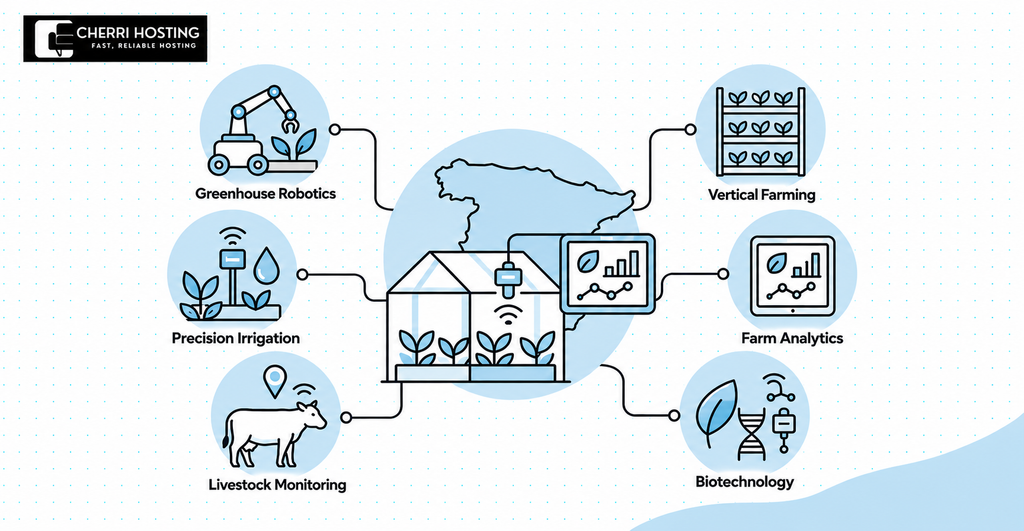
Leading Spanish Agritech Startups and Their Technologies
The following selection covers 15 companies with identifiable agricultural or closely related technology activities. It includes startup-stage businesses and older companies that have developed beyond the early startup phase. The numbering identifies companies for comparison, not an official performance ranking.
| No. | Company | Primary Technology | Main Application |
| 1 | GrodiTech (Grodi) | Robotics and computer vision | Greenhouse monitoring |
| 2 | Voltrac | Electric autonomous machinery | Agricultural field operations |
| 3 | Spherag | Connected irrigation technology | Water management |
| 4 | IKOS Advanced | AI and agricultural sensors | Precision irrigation |
| 5 | Innogando | GPS and connected devices | Livestock monitoring |
| 6 | Neboda | Automated vertical farming | Indoor crop production |
| 7 | Ekonoke | Controlled-environment agriculture | Indoor hop cultivation |
| 8 | VisualNACert | AI and farm management software | Crop data and traceability |
| 9 | Groots | Hydroponic vertical farming | Leafy greens and herbs |
| 10 | Green in Blue | Aquaponics | Water-efficient cultivation |
| 11 | Ficosterra | Marine biotechnology | Agricultural biostimulants |
| 12 | Microfy.AI | AI and microscopic imaging | Agricultural product analysis |
| 13 | BioFlyTech | Insect biotechnology | Biological ingredient production |
| 14 | Tebrio | Industrial insect biotechnology | Feed ingredients and biological products |
| 15 | KOA Biotech | Biosensors and AI | Aquaculture disease monitoring |
The selection deliberately includes three adjacent agrifoodtech businesses: BioFlyTech, Tebrio, and KOA Biotech. Their work involves biological production or aquaculture rather than conventional crop farming. They are identified separately to avoid confusing agritech with the broader agrifoodtech sector.
Comparison of Startup Locations, Specializations, and Funding
Spain’s agritech activity spans Almería, Valencia, Zaragoza, Lugo, Barcelona, and other innovation centers. Individual companies specialize in different agricultural problems, so their performance should not be compared using funding alone. Some businesses disclose investment amounts, while others publish limited financial information.
| Company | Verified Location or Regional Connection | Funding Information |
| GrodiTech | Almería | €2.5 million round announced in February 2026 |
| Voltrac | Valencia | Seed-stage funding reported; confirm cumulative amount |
| Spherag | Zaragoza | No comparable verified total included |
| IKOS Advanced | Almería | Investment activity reported in 2026; amount not stated here |
| Innogando | Lugo | Funding reported in startup databases |
| Neboda | Vigo | Seed-stage company |
| Ekonoke | Spain | No comparable verified total included |
| VisualNACert | Rafelbunyol, Valencia | No comparable verified total included |
| Groots | Spain | No comparable verified total included |
| Green in Blue | Spain | No comparable verified total included |
| Ficosterra | Burgos | No comparable verified total included |
| Microfy.AI | Spain | No comparable verified total included |
| BioFlyTech | Spain | Financing reported; confirm current cumulative total |
| Tebrio | Salamanca | Industrial financing reported |
| KOA Biotech | Barcelona | Startup funding reported |
Funding availability varies. An undisclosed amount does not mean a company has received no investment.
GrodiTech provides a clearly documented investment example. Seedtable records approximately $3 million in funding associated with its February 2026 financing event. Contemporary coverage describes the same round as €2.5 million, illustrating why currency and reporting dates matter.
Investors should check whether reported amounts represent one financing round or total funding. Farmers should place more importance on products, customer support, and demonstrated field performance. These differences make a combined technology and business comparison more useful than a simple funding ranking.
How Were These Agritech Startups Selected?
These 15 companies were selected for identifiable agricultural technology, Spanish business connections, and available evidence of commercial activity. The assessment considered product relevance, investment information, agricultural applications, and market presence. It also distinguished core farming technologies from related agrifoodtech activities.
The research draws on Spain’s ICEX agritech ecosystem mapping, startup directories, and official company information. This is an editorial selection rather than a recognized national ranking. No numerical performance scores have been assigned without comparable evidence for every company.
Innovation, Funding, and Business Growth
Technology development, reported funding, and business growth were three important selection factors. For example, GrodiTech develops greenhouse robotics, while Voltrac is working on autonomous electric agricultural machinery. Spherag and IKOS Advanced focus on irrigation management and agricultural data.
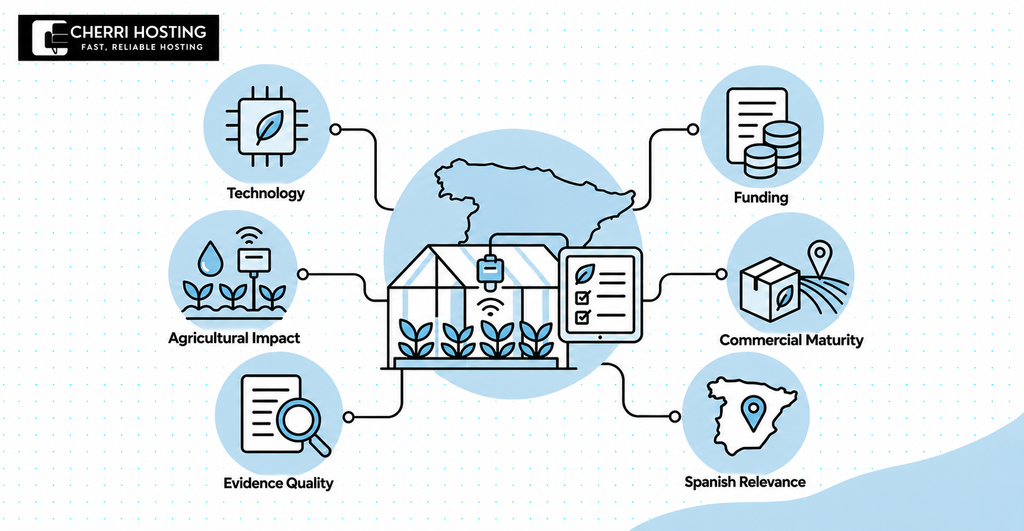
The evaluation considered:
- Technology: Products such as autonomous machines, sensors, and agricultural software.
- Funding: Published investment rounds and identified investors.
- Commercial maturity: Evidence of available products, pilots, and customer use.
- Spanish relevance: Headquarters, founding activity, or substantive operations in Spain.
- Evidence quality: Official product information and attributable company reports.
Spain’s broader agrifoodtech sector attracted an estimated €123 million in investment during 2025, down 31.3% from 2024. The Eatable Adventures report describes increasing investor attention to commercially validated technologies. These figures cover agrifoodtech generally, not just the 15 selected companies.
Agricultural Impact and Commercial Adoption
Agricultural impact was assessed through practical applications and available evidence of adoption. Technologies were considered relevant when they addressed problems such as irrigation control, crop inspection, or livestock tracking. However, a functioning product does not automatically establish improved farm profitability.
Commercial evidence can include paying customers, field deployments, and repeat use. For example, Spherag publishes an irrigation case study involving the Spanish cherry producer Frutas Mifra. VisualNACert also publishes customer information and examples of digital agricultural management.
Environmental savings require additional scrutiny. A company’s reported reduction in water use may apply only to one installation or agricultural season. The original baseline, measurement period, and growing conditions should accompany important performance claims.
Leading Agritech Startups in Spain: Company Profiles
Spain’s agritech companies work across four main areas: automation, digital agriculture, irrigation, and biotechnology. Each area solves a different farming or production problem. The following profiles explain what the 15 selected businesses actually offer.
Agricultural Robotics and Automation Startups
1. GrodiTech — Greenhouse Monitoring Robots
GrodiTech, also known as Grodi, was founded in Almería in 2022. Its VEGA 11 robot uses cameras and computer vision to examine greenhouse crops. This technology helps growers collect information about plant conditions and potential problems.
The company announced a €2.5 million financing round in February 2026. Investors included Swanlaab, Axon Desarrollo Andalucía, and CDTI-linked financing. The round was intended to support industrial development and commercial expansion.
2. Voltrac — Electric Agricultural Machinery
Voltrac develops an electric tractor platform called Thor. The company aims to automate agricultural operations using electric propulsion and digital controls. Its technology targets fieldwork that traditionally depends on diesel machinery and human operators.
Electric agricultural equipment may reduce fuel consumption under suitable operating conditions. However, battery capacity, machine price, maintenance, and charging requirements influence practical value. Farmers should assess demonstrated performance before replacing existing equipment.
3. Innogando — Connected Livestock Management
Innogando develops technology for livestock monitoring and management. Its RUMI system uses GPS-enabled devices to help farmers locate cattle. Connected monitoring can also help operators review animal movement and herd activity.
The technology addresses time-consuming livestock management work. Its financial value depends on herd size, coverage, equipment reliability, and subscription costs. Innogando is therefore better compared with livestock technology companies than crop-monitoring startups.
4. Neboda — Automated Vertical Farming
Neboda develops controlled indoor cultivation systems using hydroponics, robotics, and automation. Its production approach focuses on crops such as leafy greens and aromatic herbs. The company is associated with Vigo in northwestern Spain.
Indoor production allows operators to manage growing conditions more closely. However, electricity costs, facility investment, and crop prices influence economic feasibility. Vertical farming should not automatically be considered cheaper or more sustainable than outdoor agriculture.
AI and Precision Agriculture Startups
5. VisualNACert — Agricultural Data and AI
VisualNACert was founded in Valencia in 2014. Its digital platform helps agricultural businesses manage field information, traceability, and operational decisions. The company now uses artificial intelligence across agricultural data and management applications.
VisualNACert reports more than 400 client companies and four million hectares digitized. These figures come from its official website and describe company-reported adoption. Its age and scale make it a mature technology business rather than a newly launched startup.
6. Microfy.AI — AI-Based Agricultural Analysis
Microfy.AI develops artificial intelligence for automated microscopic analysis. Its Honey.AI application examines honey samples and supports agricultural product quality assessment. The technology combines digital imaging with automated interpretation.
This is a specialist application rather than broad farm management software. It may be relevant to honey producers and laboratory testing organizations. Buyers should compare testing accuracy, operating costs, and applicable quality standards.
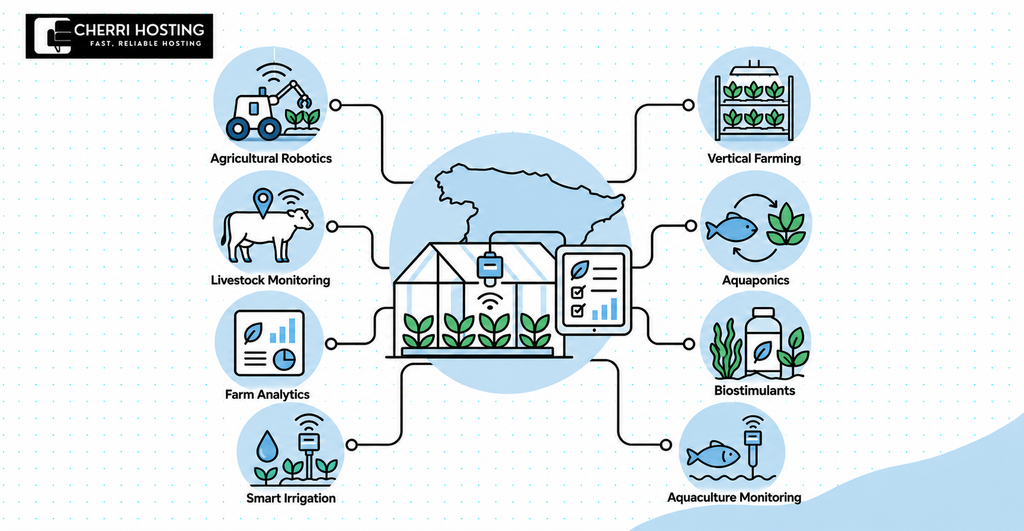
Smart Irrigation and Water Management Startups
7. Spherag — Connected Irrigation Systems
Spherag provides remote irrigation monitoring and control technology. Its connected devices can help operators manage valves, monitor equipment, and receive alerts. The system is relevant to farmers and irrigation organizations managing distributed infrastructure.
The company worked with Telefónica Tech on an irrigation project at Frutas Mifra. Spherag reports that the installation reduced water consumption by more than 30%. This is a project-specific reported result rather than a guaranteed saving for every farm.
8. IKOS Advanced — Precision Irrigation
IKOS Advanced develops agricultural monitoring technology using sensors and artificial intelligence. Its system helps growers review soil and environmental information when planning irrigation. The company operates within Almería’s agricultural innovation ecosystem.
Precision irrigation can reduce unnecessary watering when recommendations match actual field conditions. Its results depend on accurate sensors, suitable installation, and farmer decisions. Buyers should seek documented outcomes for comparable crops and farms.
9. Green in Blue — Aquaponics Systems
Green in Blue develops aquaponic technology combining plant cultivation and fish production. Aquaponics circulates nutrient-rich water through a managed growing system. This allows water to be reused within the production process.
The technology differs from conventional field irrigation. Its suitability depends on available space, energy use, operating skills, and the chosen crops. Potential buyers should examine full operating expenses rather than water savings alone.
Sustainable Farming and Agricultural Biotechnology Startups
10. Ekonoke — Indoor Hop Cultivation
Ekonoke develops controlled-environment technology for growing hops indoors. Hops are agricultural crops primarily used in brewing. The company aims to make production less dependent on outdoor weather conditions.
Indoor cultivation offers greater control over temperature and other growing conditions. However, indoor facilities require electricity, equipment, and environmental management. Commercial viability depends on production costs and customer demand.
11. Groots — Hydroponic Food Production
Groots develops vertical farming systems for leafy greens and aromatic herbs. Its hydroponic approach grows plants using nutrient-rich water rather than conventional soil. The business belongs to Spain’s controlled-environment agriculture sector.
Hydroponic production can support water recirculation and controlled growing conditions. However, environmental performance depends on energy use and the production method being compared. Reported water savings should be assessed against a clearly defined agricultural baseline.
12. Ficosterra — Seaweed-Based Agricultural Products
Ficosterra develops agricultural biostimulants using marine-derived ingredients. Biostimulants are products designed to support natural plant processes and growth. The company applies seaweed biotechnology to agricultural inputs.
These products differ from irrigation equipment or robotic machinery. Their performance depends on crop type, application methods, and growing conditions. Farmers should review trial results before assuming a particular yield improvement.
13. BioFlyTech — Insect Biotechnology
BioFlyTech operates in the insect biotechnology sector. Its activities involve producing insect-derived ingredients for commercial applications. These products can serve animal nutrition and other biological industries.
BioFlyTech represents agricultural biotechnology within the broader agrifood supply chain. It does not provide conventional precision irrigation or crop-monitoring software. Its commercial performance should be evaluated using production capacity, customers, and financial disclosures.
14. Tebrio — Industrial Insect Production
Tebrio develops industrial-scale production using mealworms known scientifically as Tenebrio molitor. Its business focuses on insect-derived products for feed and other industrial applications. The company is associated with Salamanca and has pursued major manufacturing investment.
Tebrio’s proposed industrial facilities involve significant production capacity and capital requirements. However, planned capacity should not be confused with verified annual output. It is an agrifood biotechnology scaleup rather than an early-stage digital farming startup.
15. KOA Biotech — Aquaculture Monitoring
KOA Biotech develops biosensor and artificial intelligence technology for aquaculture. Its systems aim to identify biological risks and support earlier disease detection. The technology targets fish farming rather than land-based crop production.
Aquaculture monitoring can help producers respond to animal health problems sooner. However, commercial benefits depend on detection accuracy, operating costs, and adoption. KOA Biotech is included as an adjacent agrifoodtech example.
How Agritech Startups Are Transforming Agriculture in Spain
Spanish agritech companies are changing farming through irrigation control, digital monitoring, and equipment automation. Spherag, GrodiTech, and Innogando provide examples of these approaches. Their practical value depends on technology performance and farmer adoption.
Solving Water Scarcity and Irrigation Challenges
Water management is a major agricultural issue in Spain. The Ministry of Agriculture reported that 80.57% of irrigated farmland used efficient irrigation methods by the end of 2023. This covered systems such as localized, sprinkler, and mechanized irrigation.
That national statistic demonstrates irrigation modernization, not the impact of any single startup. Spherag adds remote management to irrigation infrastructure, while IKOS Advanced supports data-based watering decisions. Both approaches can improve management when properly installed and maintained.
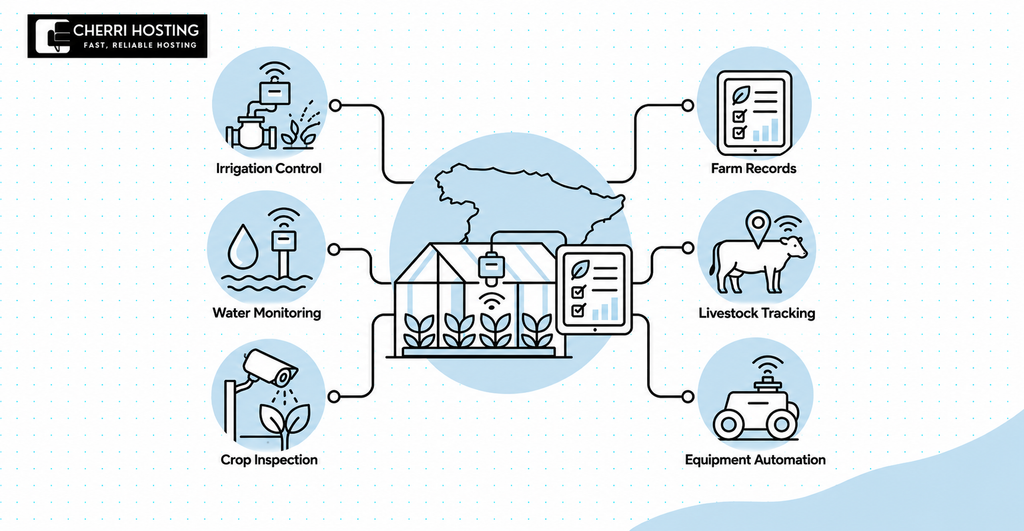
Spherag’s Frutas Mifra case provides a specific example. The installation covered a cherry-growing operation exceeding 65 hectares. The company reported water savings above 30% after implementing connected irrigation controls.
Improving Crop Monitoring and Farm Productivity
Crop monitoring technology helps farmers identify changing conditions and make more informed decisions. GrodiTech uses greenhouse images, while VisualNACert manages agricultural information. IKOS Advanced combines monitoring data with irrigation support.
These systems can reduce the need for repeated manual inspections. They can also organize records that would otherwise be spread across separate tools. However, more data does not automatically result in higher crop yields.
Practical benefits should be measured against previous farming methods. Useful indicators include crop quality, inspection time, treatment costs, and resource consumption. Startups should publish these results with clear measurement periods.
Reducing Labor Costs Through Agricultural Automation
Agricultural automation can reduce repetitive work involving crop inspection, livestock location, and equipment control. GrodiTech automates greenhouse monitoring, while Innogando supports remote cattle tracking. Spherag allows irrigation operators to control connected equipment without visiting every valve.
Voltrac is exploring a different form of automation through electric machinery. Autonomous field operations could reduce some direct driving tasks when commercially validated. However, safety, maintenance, machine reliability, and supervision remain important.
Farmers should calculate labor savings rather than assume them. Equipment costs may offset time saved during early use. The strongest investment case combines measured time savings with dependable equipment performance.
Top Agritech Startup Hubs in Spain
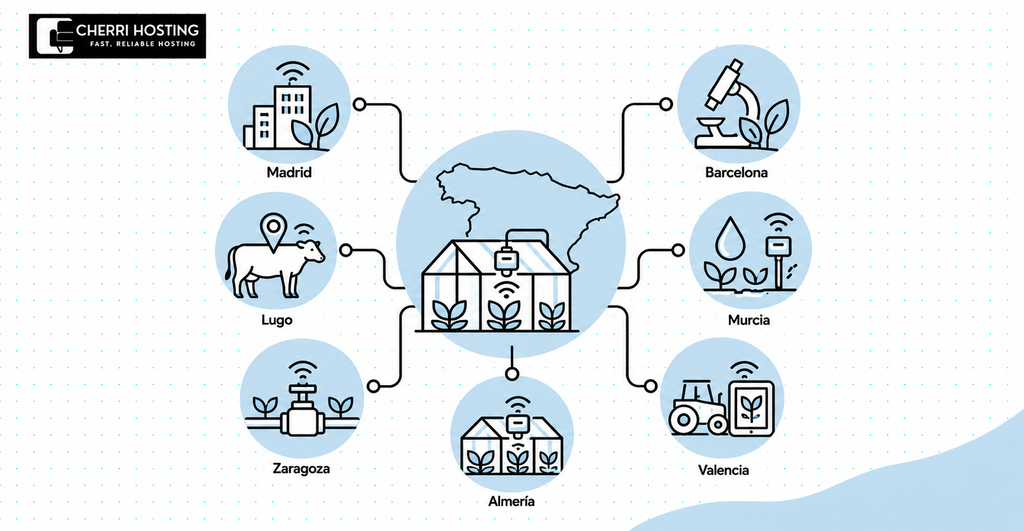
Madrid, Barcelona, Murcia, Valencia, and Almería are major agritech centers in Spain. The ICEX and Cajamar 2024 mapping documents their concentration of agricultural technology businesses. These figures refer to companies rather than startups alone.
| Province | Agritech Companies |
| Madrid | 109 |
| Barcelona | 93 |
| Murcia | 76 |
| Valencia | 74 |
| Almería | 60 |
Source: ICEX and Cajamar, Mapping the Agritech Ecosystem in Spain, December 2024.
Barcelona and Catalonia
Barcelona combines startup services, research activity, and access to investors. The surrounding Catalonia region supports innovation in biotechnology, agricultural software, and food production. KOA Biotech provides an example of technology development within the broader biological production sector.
Companies in this ecosystem can access technical expertise and potential commercial collaborators. However, a large technology startup population does not necessarily mean a region leads agritech funding. Sector-specific investment figures are needed for that comparison.
Madrid, Valencia, and Murcia
Madrid recorded 109 agritech companies in the ICEX provincial mapping. Valencia recorded 74, while Murcia recorded 76. These areas offer different combinations of software development, agriculture, and business services.
Valencia is connected with Voltrac and VisualNACert. Murcia provides practical settings for agricultural irrigation technology and production management. These examples illustrate why regional specialties matter when assessing startup opportunities.
Andalusia and Other Agricultural Innovation Regions
Almería recorded 60 agritech businesses in the ICEX mapping. Its greenhouse agriculture provides practical conditions for crop monitoring and irrigation technology. GrodiTech and IKOS Advanced illustrate this regional connection.
Zaragoza is associated with Spherag’s irrigation development. Lugo is linked with Innogando’s livestock technology. Together, these locations demonstrate that Spanish agritech innovation extends beyond the largest cities.
Agritech Startup Funding and Investment in Spain
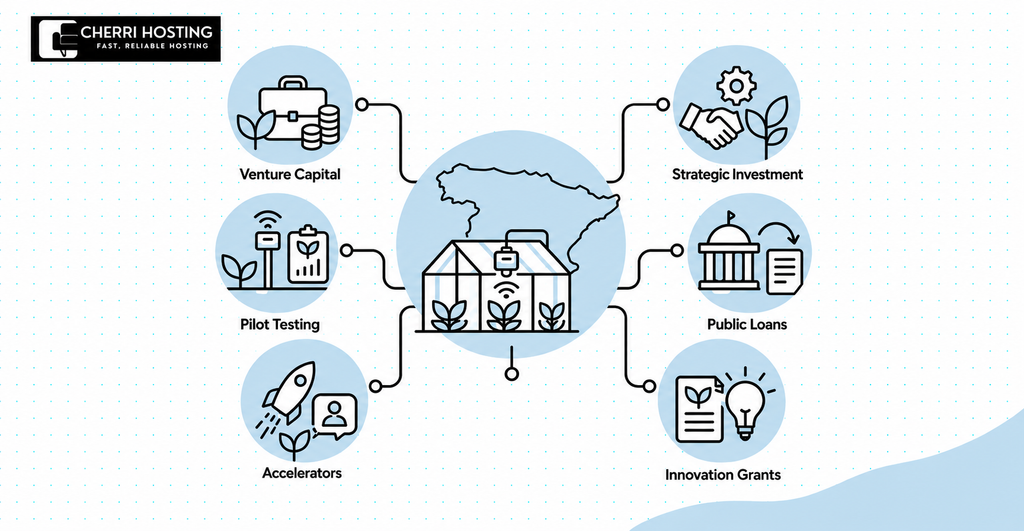
Spanish agritech businesses receive financing through venture capital, strategic investment, government loans, and innovation grants. Funding supports product development, field testing, manufacturing, and commercial expansion. However, investment availability differs across agricultural technology categories.
The 2025 Eatable Adventures report estimated €123 million invested in Spain’s broader agrifoodtech sector. This represented a 31.3% decrease from 2024. The figures cover more than agritech startups alone.
Funding Rounds and Investors in Spanish Agritech
GrodiTech’s February 2026 round provides a documented financing example. The company raised €2.5 million with participation from Swanlaab, Axon, and CDTI-related investment. The financing supported development and expansion of its greenhouse robotics technology.
Investment reporting requires careful interpretation. A company may announce equity financing, public loans, grants, or a combination of instruments. These amounts should not automatically be added together without checking whether reports describe the same event.
Private funding databases can help identify further activity. Seedtable tracks startup stages and reported financing, while official announcements confirm specific events. Investors should verify both the date and currency before comparing businesses.
Government Grants, Accelerators, and Startup Support
Spain offers public financing instruments for eligible agricultural technology companies. ENISA’s AgroInnpulso program provides participative loans, while CDTI manages innovation funding. Accelerators such as Eatable Adventures also support testing and commercialization.
| Support Program | Published Terms |
| ENISA AgroInnpulso | Participative loans of €25,000–€1.5 million |
| CDTI NEOTEC 2026 | Grants up to €250,000 under standard conditions |
| CDTI NEOTEC 2026 with eligible doctoral hiring | Grants up to €325,000 under specified conditions |
| Agrifood accelerators | Mentoring, investor access, and pilot opportunities |
ENISA financing is repayable and is not equivalent to a grant. CDTI’s 2026 NEOTEC application period ran from April 14 to May 14. Applicants should consult official program pages for future deadlines.
CDTI subsequently announced an increase in NEOTEC’s 2026 budget to €40 million. Part of that expansion was directed toward qualifying dual-use technologies. It should not be interpreted as €40 million reserved specifically for agricultural startups.
How to Compare Spanish Agritech Startups
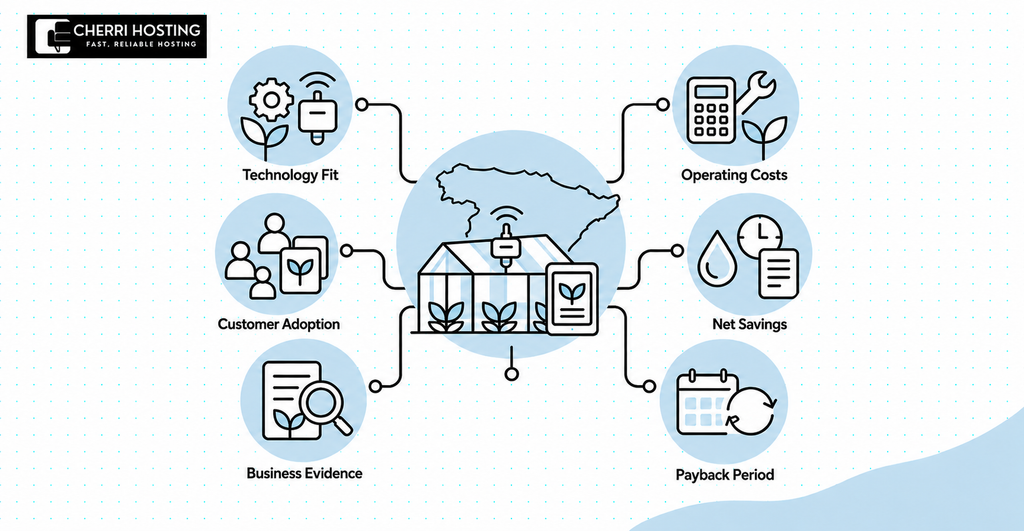
Compare Spanish agritech startups through technology fit, commercial evidence, and measurable financial benefits. Farmers and investors may prioritize different indicators. A consistent framework prevents funding announcements from overshadowing product suitability.
Technology, Products, and Target Customers
Start by identifying the problem a product is designed to solve. For example, Spherag focuses on irrigation control, while Innogando targets livestock monitoring. GrodiTech serves greenhouse production rather than conventional open-field farming.
| Company | Main Customer | Problem Addressed |
| Spherag | Growers and irrigation managers | Water control and infrastructure monitoring |
| GrodiTech | Greenhouse growers | Repetitive crop inspection |
| Innogando | Livestock farmers | Animal tracking |
| VisualNACert | Agricultural businesses | Field data and operational management |
| Ficosterra | Crop producers | Plant support through biological products |
Product compatibility also matters. Some technologies require connected equipment, reliable communications, or specialist support. Buyers should confirm operating requirements before making financial commitments.
Funding, Business Growth, and Market Adoption
Business growth should be evaluated using customers, revenue evidence, partnerships, and repeat product use. Funding can help a startup expand, but it does not prove market demand. Verified deployments often provide better evidence of commercial progress.
VisualNACert reports more than 400 client companies and four million hectares digitized. Spherag provides published customer projects, while GrodiTech has documented recent investment. These indicators measure different aspects of business development and should remain separate.
Investors should also examine operating costs and customer retention. Revenue information may be unavailable for privately held companies. In that situation, financial uncertainty should be acknowledged rather than filled with estimates.
Agricultural Benefits and Return on Investment
Agricultural return on investment compares technology costs with financial benefits from savings or additional revenue. Savings may come from water, labor, energy, or agricultural inputs. Results must account for installation, maintenance, and ongoing subscriptions.
Consider a hypothetical irrigation technology investment. The example uses €12,000 in initial costs and €3,000 in annual net savings. It does not represent a verified result from any startup in this article.
| Financial Factor | Illustrative Amount |
| Equipment and installation | €12,000 |
| Annual water savings | €2,000 |
| Annual labor savings | €1,500 |
| Annual maintenance | €500 |
| Annual net savings | €3,000 |
| Simple payback period | 4 years |
Simple payback period = Initial investment ÷ Annual net savings.
The calculation produces a four-year payback period. It excludes borrowing costs, taxes, equipment replacement, and changes in crop income. Actual results will depend on the farm and technology.
Challenges Facing Agritech Startups in Spain
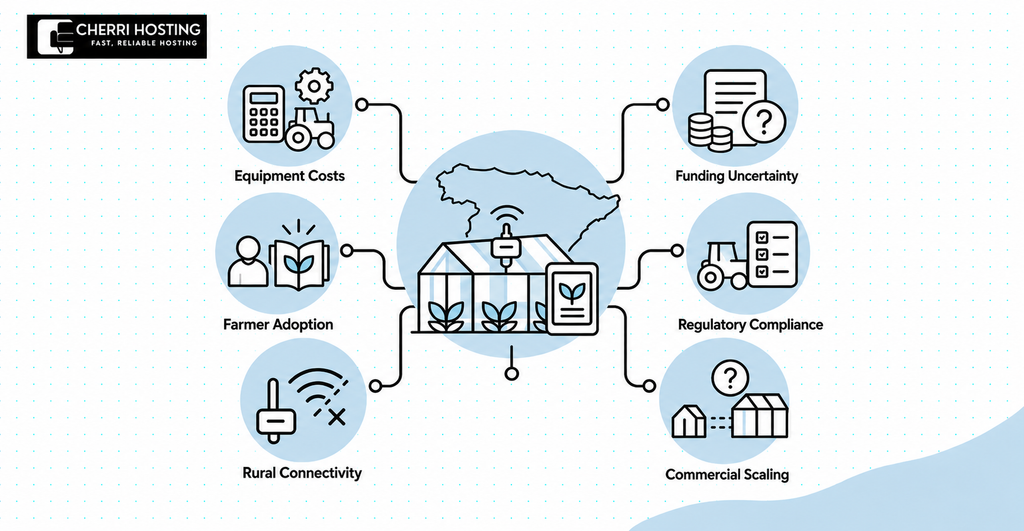
Spanish agritech startups face equipment costs, adoption barriers, funding uncertainty, and product-specific regulatory requirements. Robotics businesses can require substantial capital, while digital platforms need reliable deployment and support. Farmers also need convincing evidence that new technology delivers value.
High Technology Costs and Farmer Adoption
Agricultural technology can involve installation and training expenses beyond its purchase price. Examples include sensor networks, autonomous machinery, and connected irrigation controls. Small farms may struggle to recover these costs quickly.
Digital skills and rural connectivity can also affect adoption. Farmers may need assistance interpreting data or maintaining equipment. Products that integrate with existing operations can reduce implementation difficulties.
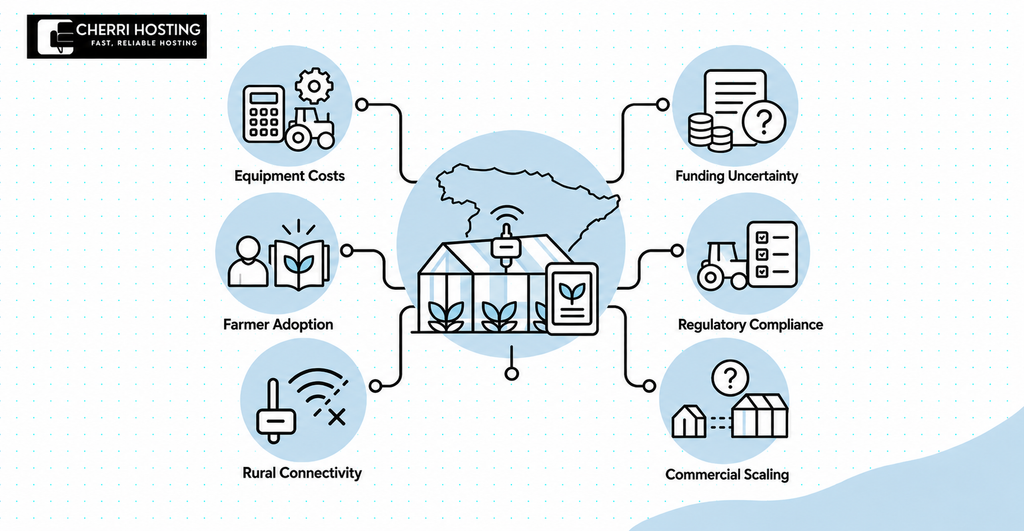
Pilot projects provide an opportunity to test performance before broad installation. Suppliers can measure water use, labor time, and operating reliability. Farmers can then decide using evidence from comparable conditions.
Funding, Regulation, and Commercialization Risks
The reported 31.3% decline in Spanish agrifoodtech investment during 2025 illustrates a more demanding financing environment. However, it does not mean funding declined equally for every technology category. Startups need to demonstrate credible customer demand and sustainable operating economics.
Regulatory requirements depend on each product’s purpose. Autonomous machinery may require safety compliance, while connected platforms may have data protection obligations. Biological agricultural products can also face relevant European Union rules.
Commercialization remains difficult after successful testing. A technology can work during a pilot without being profitable at scale. Investors should distinguish experimental performance from established revenue-generating operations.
Future Trends in Spain’s Agritech Industry
Spain’s agritech development is increasingly focused on AI, robotics, connected farming, and resource-efficient production. Companies such as GrodiTech, Spherag, and VisualNACert already offer relevant technology examples. Future expansion will depend on affordability, product reliability, and customer adoption.
Artificial Intelligence, Robotics, and Smart Farming
Artificial intelligence can help interpret crop images and agricultural sensor information. Robotics can automate monitoring or selected machinery operations. These tools address different tasks and should not be treated as interchangeable.
Spain’s 2026 agritech industry reporting identifies AI and robotics as prominent areas of startup activity. It also notes investment rounds involving GrodiTech, IKOS Advanced, and MULA. Such activity indicates commercial interest but does not guarantee future returns.
The most useful future developments will address practical farm requirements. Farmers need accurate recommendations, dependable equipment, and clear operating costs. Developers must also consider connectivity, training, and ongoing technical support.
Sustainable Agriculture and Climate-Smart Technologies
Smart irrigation, seaweed-based biostimulants, and controlled-environment farming are important sustainability-related approaches. Spherag supports irrigation management, while Ficosterra develops agricultural inputs using marine biotechnology. Ekonoke and Groots explore production under controlled growing conditions.
Environmental outcomes should be measured rather than assumed. Water consumption, energy demand, and material use can vary significantly between installations. Independent field comparisons help establish whether a technology offers net benefits.
Climate-related agricultural pressure may increase demand for resource management tools. However, future adoption will depend on cost, policy, and farm-level results. Companies with documented performance may be better positioned to attract customers.
Frequently Asked Questions
What Are the Top Agritech Startups in Spain?
Notable Spanish agritech companies include GrodiTech, Voltrac, Spherag, IKOS Advanced, Innogando, and Neboda. They specialize in technologies such as agricultural robotics, irrigation management, and controlled farming. The most suitable company depends on the technology or investment category being researched.
What Is the Difference Between Agritech and Foodtech?
Agritech focuses primarily on agricultural production, while foodtech covers technologies used across food development and processing. For example, smart irrigation and agricultural robotics are agritech applications. Alternative protein production and some food manufacturing technologies may fall within the broader agrifoodtech sector.
Which Spanish Agritech Startups Use Artificial Intelligence?
GrodiTech, IKOS Advanced, VisualNACert, and Microfy.AI use AI-related technology in their products. Their applications involve crop monitoring, agricultural information, or automated analysis. However, each company’s actual AI functionality should be examined separately.
Which Companies Focus on Smart Irrigation?
Spherag and IKOS Advanced are relevant Spanish companies for smart irrigation technology. Their products use connected monitoring or agricultural data to support watering decisions. Farmers should compare equipment compatibility, implementation costs, and verified savings.
Who Invests in Spanish Agritech Startups?
Agritech financing involves venture investors, public institutions, and specialist funding programs. GrodiTech’s 2026 round included Swanlaab, Axon, and CDTI-linked participation. Other startups may access eligible ENISA loans, grants, or accelerator programs.
Which Cities Have the Most Agritech Companies?
Madrid and Barcelona lead the ICEX provincial mapping, followed by Murcia, Valencia, and Almería. The report recorded 109 companies in Madrid province and 93 in Barcelona province. These figures include established businesses and should not be described as startup-only counts.
Is Spain a Good Market for Agritech Investment?
Spain offers opportunities in irrigation, agricultural automation, and digital farm management. However, investment outcomes depend on valuation, customers, competition, and financial performance. Funding trends alone cannot establish whether a particular startup is a good investment.
How Can Farmers Benefit From Agritech Startups?
Farmers can use agritech to monitor crops, manage irrigation, track livestock, and automate selected tasks. Companies such as Spherag, Innogando, and GrodiTech address different operating needs. Farmers should test products and compare measurable benefits against total ownership costs.
Conclusion: The Future of Agritech Startups in Spain
The top agritech startups in Spain demonstrate how technology is being applied to agricultural production and resource management. GrodiTech, Voltrac, Spherag, and IKOS Advanced represent distinct approaches to automation and precision farming. Other companies contribute through digital management, controlled cultivation, and biotechnology.
Funding offers insight into investor interest, but it cannot replace evidence of commercial success. Farmers should examine product reliability, costs, and verified field outcomes. Investors should consider customer adoption, company maturity, and financial sustainability.
The most useful agritech innovation solves a measurable agricultural problem at a viable cost. Spain’s agricultural sector provides opportunities to test and develop such technologies. Careful comparison remains essential before choosing a supplier, partner, or investment.